
Scroll down to see descriptions.
-
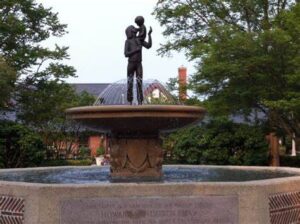
- Friends by Sylvia Shaw Judson was commissioned by Robert Douglas Stuart Jr., a Lake Forest resident, and CEO of Quaker Oats, and completed in 1969. The statue was Judson’s last major work and her only sculpture to feature two human figures joined together. A copy of the statue was produced at a foundry in New York City in 1982 and installed in Market Square’s central fountain later that year. The fountain was then adorned with a plaque bearing the erroneous title “Girl with Baby on Shoulder,” which was most likely the name used by the foundry to distinguish the statue from other casts. In 2014, Lake Forest resident Paul Melichar, a sculptor who had studied Judson and her work, noticed the error on the plaque and spent the next two years lobbying for the City of Lake Forest to change the title of the sculpture displayed on the plaque to the correct one. Thanks to the Historic Preservation Commission, the plaque was replaced in 2016 with one displaying the correct title.
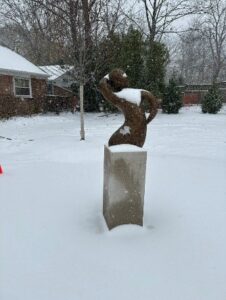
- Boy Dancing was sculpted by Sylvia Shaw Judson specifically for the architectural niche in which it now stands. Her father, Howard Van Doren Shaw, included the niche, which is located near the top of the facade of a building on Market Square’s north side, as part of his original design for the shopping center. Judson was a teenager when her father was designing Market Square and already showed promising signs of becoming an accomplished sculptor. Shaw designed the niche to hold one of her sculptures and also planned for a fountain featuring another of her sculptures as its centerpiece. Years later, Judson sculpted the likeness of a young model training for the ballet who posed for her. On July 6, 1975, the resulting statue was finally installed in the niche which had remained empty until then.
- Ex Libris, designed by Michael Croydon and fabricated by Daniel T. Blue, was commissioned by the Deer Path Art League for the Lake Forest Library’s Centennial, and installed in 1996. The title of the sculpture is a reference to the Latin term used on bookplates that means “from the books of …” and suits the conceptual basis of the work itself. Following Croydon, this work “manages a highly respectful updating of the image of the Library through the sculpture’s modern form, but with profound homage paid to traditional information and knowledge.” The sculpture is composed of six individual elements, each representing a grouping of books, arranged in an arc across the front lawn of the building. The books, generally to human scale, vary in size as do human bodies. In addition to signifying knowledge, these books are also a representation of people gathered together.
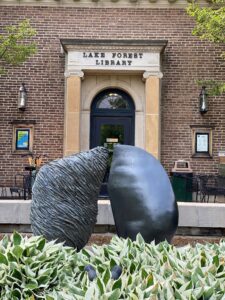
- Untitled, sculpted by local artist Peter Hessemer, was gifted to the Lake Forest Library by the family and friends of Alfred Medica, an avid reader of history who frequented the Library, in his memory. The sculpture was installed near the Library’s front entrance in July 2007 and dedicated the following November. Hessemer, himself a regular at the Library, gladly accepted the invitation to create a piece as an outdoor memorial to Medica. Untitled became the first sculpture that Hessemer designed for a public space. Although Hessemer and Medica did not know one another, the sculpture can be seen as a representation of the idea that a shared space can form connections between individuals. According to Hessemer, Untitled, despite being abstract, “does relate to the idea of two people … it’s like two people existing in one space.” Peter Hessemer, a Lake Forest resident and professor of art at Oakton Community College in Des Plaines, is an award-winning sculptor and ceramicist. Rich textures and organic forms serve as the trademark features of his sculptural work. He received his BFA from the Tyler School of Fine Arts at Temple University in 1974 and his MFA from the University of Chicago in 1976.
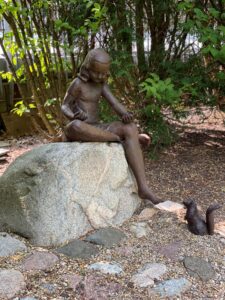
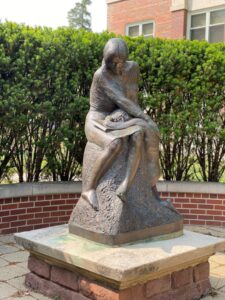
- Girl Feeding Three Squirrels by the late Lake Forest-based artist Dorothy Hobbs Boehm was installed outside the Lake Forest Library in 1979 in memory of Louise Wells Kasian, the Library’s director from 1968 to 1978. Following the lead of Sylvia Shaw Judson, Boehm used her own children as models for the creation of endearing life-size figures immersed in a world of enchantment and serenity. In many ways, Girl Feeding Three Squirrels is an embodiment of Boehm’s creative spirit and her love of nature, children, books, and art. Through email correspondence in September 2000, she explained, “The sculpture for me represents the interests of a woman who devoted her life to bringing awareness to others, especially children, through books and the study of our world of nature.” Dorothy Hobbs Boehm, born in Toledo, Ohio, and raised in Highland Park, Illinois, was the daughter of architect and artist Morris Henry Hobbs. As a child, Boehm was encouraged to work in various artistic media by her father, who let her use his studio to do so. She majored in Fine Arts at the University of Iowa and Northwestern University but put her formal education on hold when the United States entered World War II. She returned to her artistic practice during the mid-1960s when the youngest of her five children was in nursery school. In 1967, she and a friend founded a ceramics studio in Lake Forest and soon after, she began teaching classes for the Deer Path Art League. By the time she received her BFA from Barat College in 1982, Boehm had already established herself as a professional sculptor.
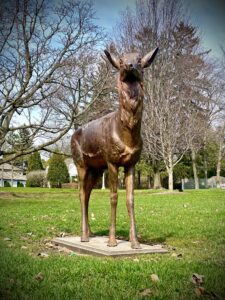
- Deer by Robert Wood The majestic deer sculpture at Triangle Park has a rich history, deeply intertwined with the development of Lake Forest. It was originally commissioned by the Thomas Byrne Family, the second owners of “Forest Lawn,” a property located at 644 East Deer Path Road, between 1901 and 1903.This stunning cast-iron stag was a creation of Robert Wood & Co. The foundry, initially known as Wood & Perot Iron Foundry of Philadelphia, had a fascinating past. In 1858, they expanded their reach by establishing a New Orleans branch, Wood, Miltenberger & Co., which became renowned for supplying the intricate cast-iron balconies, railings, and fencing seen in New Orleans’ Garden District. Though highly successful, this operation closed with the onset of the Civil War. After the war, Elliston Perot moved to New York, but Robert Wood continued the business with new partners, Irah Case and Thomas Root, operating as Robert Wood & Co. until 1879. The quality of Wood’s work suggests he employed not just skilled technicians, but true artists. Around 1901, Thomas Byrne, an avid sportsman, enlisted a Japanese landscape gardener to create a Japanese garden at Forest Lawn. Numerous small sculptures were ordered for this project, with Robert Wood’s cast-iron stag being the most detailed and well-modeled. Byrne believed a deer statue was fitting for Deerpath Road, given the area’s significant deer population, though it’s worth noting the statue depicts a European species, not native to Lake Forest. The statue originally featured antlers, which were later removed. For many years, a playful Halloween tradition saw Lake Forest College students “borrowing” the deer, only to return it to the property days later. Eventually, the property’s subsequent owners, the Muzzy family, generously donated the statue to the City of Lake Forest. In the late 1960s, the deer found its permanent home in Triangle Park, where residents continue to adorn it with seasonal decorations.
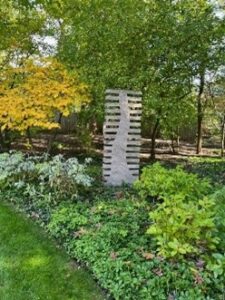
- Spirit Tree by Jesús Bautista Moroles The sculpture in the center of the modern garden mirrors the local use of curvilinear design. Titled Spirit Tree, the award-winning sculptor Jesús Bautista Moroles (1950-2015) carved the pink granite to reflect a beautifully curved center image in the rectangle of stone. Purchased and displayed at Maxine and Tom Hunter’s East Lake Forest home, it was donated to the museum in 2024. The positioning in this garden is designed to allow the viewer to see how the sculpture’s curve reflects the curve of Deerpath. The design of the roadway was platted along a naturally derived route from the train station to the lake to emulate a typical deer’s path.
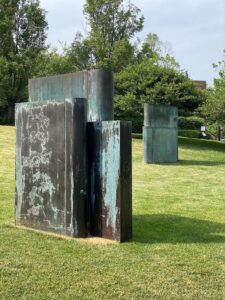
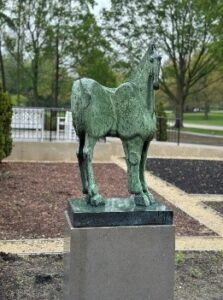
- The Narrow Horse by Jözef Sumichrast Local artists and sculptors have served the community for generations, bringing unique styles and perspectives to the ornamentations around our homes. The Narrow Horse, by Lake Forest resident Jözef Sumichrast (1948-2023), explores the relationship between the second, third and fourth dimensions. Sumichrast explains light and the participation of the viewer gives the artist’s work its fourth dimension. His bronze sculptures were modeled in wood and cardboard, then cast in bronze. He then applied heat and chemicals selectively to the metal to create the unique patina that emphasized the planes of his work. This sculpture was graciously donated to the museum by his wife Susie Sumichrast in 2025 in his memory.
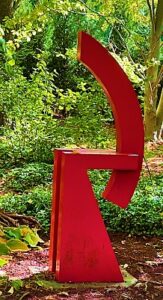
- Sparticus by Francis Porter Riggs (1922-2016) from the estate of Maxine and Tom Hunter-Francis Riggs (1922-2016) graduated with a degree in industrial design from the Pratt Institute. Frank, as he was known, taught part time in the design department at Brigham Young University, while pursuing his lifelong love of contemporary sculpture. He worked in aluminum, frequently painted in the red used in this piece, to create shapes that invite visitors to view the sculpture from different positions. As a formalist sculptor, his work was non-interpretive abstraction, focusing on the interplay of shapes: “I create intuitively by adjusting these shapes until I feel right about their organization.” Midcentury and modern gardens were frequently adorned with more abstract art like this piece, creating a focal point with color and shape.
- Embrace by Janet Austin The sculpture at the end of the allée of trees is entitled Embrace. This commissioned piece by artist Janet Austin was donated by Happie Taunque Datt. Datt explained, “As an active member of the Lake Forest community, this donation to the History Center is a way to thank the community and to remind future citizens to remember those came before us.” Sculpted into the figure are Datt’s words: “Aspirations led me here to leave a legacy of love for this community that embraced me and my own.”
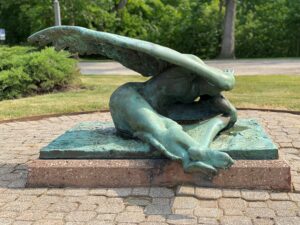
- The Wounded Angel by Michael Croydon was completed in 1975 and purchased by Lake Forest College in 1981. The sculpture was dedicated in memory of Ellen Mosey, a longtime and beloved director of public affairs at the school. The class of 1973 raised the funds for the purchase. Michael Croydon was born near London and educated at Goldsmiths College of Art, the Ealing School of Art, and the Royal College of Art. His work in architectural sculpture began in the early 1960s when he was teaching in Kenya at the University of East Africa. In 1968, Croydon was appointed a professor of art at Lake Forest College where he taught painting, photography, drawing, art history, and sculpture. He retired in 1995. His work is internationally recognized and represented in public and private collections throughout Europe, the United States, Canada, Africa, and Japan.
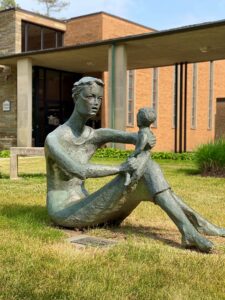
- Mother and Child by Michael Croydon was completed in 1999 and dedicated to Louise Smith Bross, a former art history professor at Lake Forest College whose family were great friends and supporters of the school. The sculpture was commissioned to honor her by her family, friends, colleagues, and students. Michael Croydon was born near London and educated at Goldsmiths College of Art, the Ealing School of Art, and the Royal College of Art. His work in architectural sculpture began in the early 1960s when he was teaching in Kenya at the University of East Africa. In 1968, Croydon was appointed a professor of art at Lake Forest College where he taught painting, photography, drawing, art history, and sculpture. He retired in 1995. His work is internationally recognized and represented in public and private collections throughout Europe, the United States, Canada, Africa, and Japan.
- Mother and Child was created by Chicago artist Margot McMahon to commemorate the 75th anniversary of St. Mary’s Parish in Lake Forest. McMahon was also asked to design the sitting area around the sculpture, which includes trees and two limestone benches that flank the sculpture. The sitting area serves as a place for parents to meet their children after school and for parishioners to rest after church services. The sculpture itself depicts a woman, either a mother or teacher, supporting a child, either her child or student. The two figures face each other at eye level, showing that they are engaged in an equal conversation. Mother and Child embodies community and togetherness, inspiring those who encounter it to spend time with one another and cherish each other’s company. Margot McMahon, a lifelong environmentalist, sculpts human, plant, and animal forms to artistically convey her hope that decisions be made to support life on earth. McMahon earned her MFA from Yale University where she taught sculpture and drawing and has also taught at the School of the Art Institute of Chicago, DePaul University, and other institutions. She has exhibited her drawings and sculptures in Chicago, New York, Washington DC, Sante Fe, and Cincinnati. The Smithsonian Institution, the Museum of Contemporary Art Chicago, the Chicago Historical Society, the Chicago Horticultural Society and Botanic Gardens, and Yale University have her sculptures in their collections. Her work is also included in private collections in Chicago, New York, London, Paris, and Tokyo.
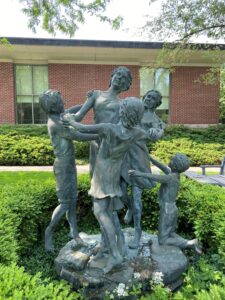
- The Joyous Dance by sculptor Susan Luery was commissioned by the husband and parents of Mary Clare Renolds Joyce following her death in February 1999. She was one of five Renolds sisters who graduated from Woodlands Academy of the Sacred Heart in Lake Forest. The sculpture was donated in her memory to the school by her family and friends. The Joyous Dance depicts Clare and her four children dancing together in a circle, full of joy and spirit. The viewer is invited to move around the composition, following the motion of the dancers intertwining with one another. With its openness and graceful display of musical movement, the piece stands as a testimony to Clare’s deep love of music and life. Susan Luery was born in Baltimore and attended the Maryland Institute College of Art, but her gift for creating romantic and timeless figurative sculpture was refined in Carrara, Italy. Her early work often involved mythological subjects and themes, and her dramatic Promethean Radiation was presented to Prince Charles and Princess Diana on the occasion of their wedding in 1981. Luery is best known for monumental works such as Babe’s Dream, the statue of baseball legend George Herman “Babe” Ruth standing heroically in front of Oriole Park at Camden Yards Stadium in Baltimore, and George Washington–Visionary, located at the historic site of Fort Cumberland.
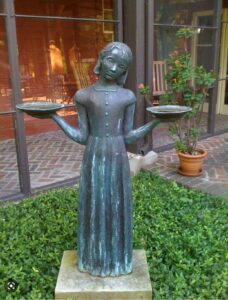
- Bird Girl by Sylvia Shaw Judson was originally commissioned by the Ryseron family of Chicago, Illinois as a garden sculpture for their summer home in Massachusetts. The statue, completed in 1936, is the likeness of a nine-year-old girl who posed for Judson as she sculpted the piece. The bowls held in each of the statue’s hands were intended to hold food or water for birds. Originally exhibited as Girl with Bowls at the Art Institute of Chicago in 1938, the piece was also exhibited as Fountain Figure, Standing Figure, and Peasant Girl. The statue was first called Bird Girl by Judson in her 1967 book For Gardens and Other Places. A bronze cast of the statue was purchased by the Trosdal family of Savannah, Georgia and installed in their family plot in Bonaventure Cemetery where it remained largely unnoticed for over 50 years. In 1994, a photo of the statue taken by photographer Jack Leigh was used as the cover image for John Berendt’s book Midnight in the Garden of Good and Evil, which was published that same year and later adapted for Clint Eastwood’s 1997 film of the same name. The book became an instant success, and soon the statue was receiving thousands of visitors. Due to concerns over the amount of traffic at the grave site, the Trosdal family had the statue removed from the cemetery and relocated to the Telfair Museums in Savannah, where the piece is now on public display. In 1995, Slyvia’s daughter Alice Judson Hayes had an additional bronze copy of Bird Girl made and installed at the Ragdale Foundation in Lake Forest. Hayes held the copyright for Bird Girl until her death in 2006, upon which the copyright was passed to her daughter, painter Francie Shaw. Sylvia Shaw Judson was the daughter of prominent architect Howard Van Doren Shaw and poet and playwright Frances Wells Shaw. She was born in 1897 in Chicago. That same year, her father purchased 50 acres of land on Green Bay Road on which he built the family’s summer home, which he named Ragdale. Judson spent the majority of her childhood summers at Ragdale, where she and her sisters would recite poems and perform plays written by their mother. She enrolled at the School of the Art Institute of Chicago and graduated in 1918, then studied under Antoine Bourdelle at the Académie de la Grande Chaumière in Paris. She married an attorney named Clay Judson in 1921 and gave birth to their daughter Alice the following year. When Alice was seven years old, she posed for the creation of her mother’s sculpture Little Gardener, which was awarded the coveted Logan Prize in 1929 and later selected for the Jacqueline Kennedy Garden at the White House in 1964. Judson had her first solo show in 1938, which was organized by the Art Institute of Chicago and then circulated to art museums in Wisconsin, Indiana, Michigan, and Ohio. In 1942, the Judsons made Ragdale their year-round residence, and Sylvia became an involved member of the Quaker group the Society of Friends. She won a competition in 1957 for a monument to Mary Dyer, a Quaker martyr hanged by Puritans in 1660, and the sculpture was then installed on the grounds of the Massachusetts State House in Boston. After her husband Clay’s death in 1960, she remarried to Sidney Haskins, and the two moved to a Quaker retirement home near Philadelphia in 1971. She would sometimes return to Ragdale to work in her studio, and she died there in 1978. She is now buried at Graceland Cemetery in Chicago.
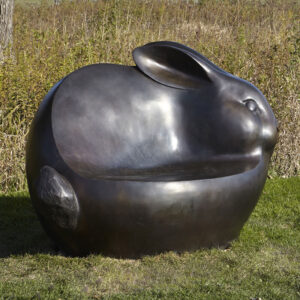
- Rabbit Bench by Seattle area artist Georgia Gerber was commissioned in 2011 by Elizabeth Uihlein, owner of the ULINE shipping supply company. Three bronze benches in total were commissioned as a set, and this piece, which depicts a rabbit, was originally installed at the ULINE corporate headquarters campus in Pleasant Prairie, Wisconsin. It was later moved to its current location at Middlefork Savanna Forest Preserve in Lake Forest. The remaining two benches, one depicting an otter, the other depicting a beaver, are still located at ULINE corporate headquarters. Rabbit Bench is a prime example of Gerber’s artistic aesthetic, which unites the natural world with imaginative formal stylization. Regarding her own artwork, Gerber explains, “I enjoy pushing shapes beyond realistic … I feel that my most successful work could be stripped of its figurative elements and the underlying form remains beautiful.” Georgia Gerber was raised on a small family farm in rural Pennsylvania where she developed a love of animals and a desire to express her passion for them through art. She studied sculpture and bronze casting at Bucknell University and earned her MFA from the University of Washington. Since 1983 she has lived on South Whidbey Island, just north of Seattle in the Puget Sound. Gerber has become one of the Northwest’s most well-known and prolific artists, with over 80 permanent installations throughout the country.
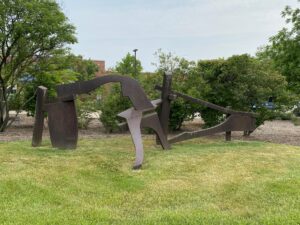
- Wind-Gap by Chicago-based sculptor Barry Tinsley was commissioned by the Deer Path Art League and presented as a gift to the City of Lake Forest in May of 1981. A site-specific work of art, Wind-Gap was created to be installed in front of the Lake Forest Recreation Center and was assembled on site. The sculpture is made of Corten steel, and its surface is coated with a linseed oil finish. The piece fuses together various abstract shapes resembling paper cutouts to create a dynamic composition that guides the viewer’s gaze along its many contours. Landscaping around the sculpture was made possible by donations from the Woodland Garden Club and Friends of the Lake Forest Recreation Department. Barry Tinsley was born and raised in Roanoke, Virginia where his father worked as a roadmaster for the Norfolk and Western railway. Frequently accompanying his father to work, Tinsley soon became fascinated by steel and later made it the primary material of his artwork. After receiving a bachelor’s degree from the University of William and Mary in Williamsburg, Virginia, he went on to receive his MFA from the University of Iowa in 1968. He later relocated to Chicago and became a full-time sculptor. Tinsley’s work can be seen throughout the Midwest and even locally with works installed at Ravinia Park and the Evanston Art Center.
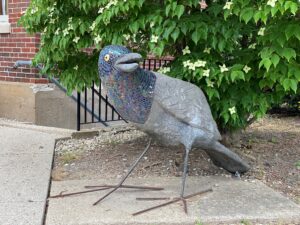
- Common Grackle by Chicago sculptor Janet Austin was completed in 2010 and installed outside of Stirling Hall, a Lake Forest ceramics studio where Austin herself has taught classes. The larger-than-life statue depicts a grackle, a bird often regarded as a nuisance for its irritating cry and tendency to pilfer the eggs of more pleasant songbirds. Despite the bird’s bothersome nature, the statue itself is quite alluring. The iridescent blue tiles covering its head along with the deep black cement composing its body are an imaginative representation of the bird’s natural plumage. Janet Austin received her Bachelor of Fine Art degree from Metropolitan State University in Denver, Colorado and her Master’s degree in printmaking and art history from Villa Schifanoia Graduate School of Fine Art in Florence, Italy. She creates work in various sculptural media, including glass, mosaics, concrete, bronze, and steel, and her pieces explore the relationships between humans and nature on a monumental scale. Austin’s work has graced public spaces across the country, including parks, zoos, botanic gardens, plazas, and transportation hubs.
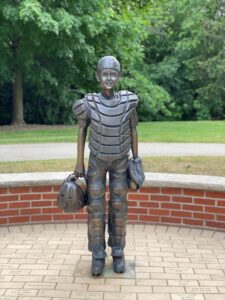
- Memorial Sculpture by Chicago artist Joseph Burlini was commissioned in 2004 by the Malin family in loving memory of their son Steven Brian Malin, Jr. The life-size, highly detailed bronze statue is a replica of a treasured photograph of Steven in his baseball uniform. The statue’s hand holds a cast iron baseball signed by members of the Malin family. Burlini allowed Maria Malin, Steven’s mother, to assist in sculpting the statue’s face while it was still being modeled in clay. The creation and installation of the statue was part of a larger project, spearheaded by Steven’s father and facilitated by the Lake Forest Parks & Recreation Facility, to rebuild the baseball field at Everett Elementary School in Steven’s honor. The community responded to Steven’s passing with overwhelming support and donated tens of thousands of dollars to the project, which culminated in the construction of a nearly professional-grade baseball field, complete with dugouts, a warning track, and an electronic scoreboard. Those who donated were honored with brick pavers bearing their names in the memorial area surrounding the statue. The field was dedicated about a year after Steven’s passing, and although not officially renamed, it has come to be known as “Malin Field” at Everett Park. Joseph Burlini is a prominent Chicago sculptor whose work is known throughout the Midwest and beyond. After receiving a degree in industrial design from the School of the Art Institute of Chicago, Burlini spent six years designing toys and other products for Sears Roebuck & Company. He later taught sculpture at the Illinois Institute of Technology and has since been commissioned to create works of art for numerous companies, institutions, and celebrities, among them Walt Disney Studios, the Pentagon, the Chicago Botanic Garden, and Michael Jordan.